Garden Collage Sheet, Backgrounds
First Impressions: A Lush, Layered Backdrop—Not Just “Pretty”
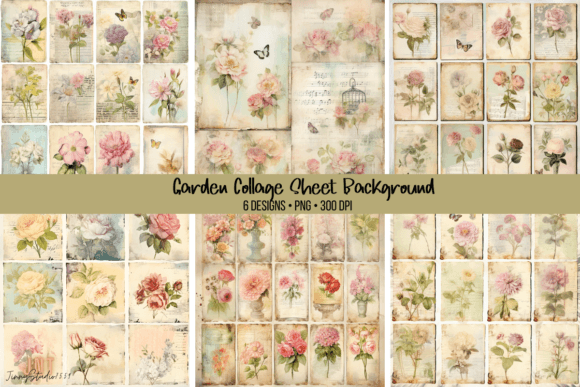
Opening the Garden Collage Sheet, Backgrounds ZIP file, I immediately scrolled through the six 12×12-inch PNGs at 3600×3600 px and 300 DPI—and felt that quiet designer satisfaction when a background doesn’t shout, but settles in with intention. These aren’t clipart gardens. They’re collaged: soft watercolor blooms layered over subtle botanical line art, faint vintage-style trellises, and delicate leafy borders—all arranged with breathing room. The mood is calm but intentional—whimsical enough for a baby onesie, refined enough for a boutique tea towel or linen pillow cover. It’s the kind of background that says “handmade with care,” not “designed to fill space.”
Real Project Test: Embroidering a Linen Tote Bag for a Local Botanical Shop
Last week, I prepped a custom order: five medium-weight linen tote bags for a small plant shop launching a spring collection. Their ask? “Something garden-adjacent—but not literal flowers on every inch.” I opened Garden Collage Sheet, Backgrounds and dropped one of the softer motifs (the one with trailing ivy and muted lavender sprigs) into my digitizing software—not as a focal design, but as a stitched backdrop behind a simple monogram.
The result? Subtle texture without visual noise. When stitched with matte cotton thread on natural linen, the design read as *woven-in*, not applied. Customers didn’t say “Oh, nice background”—they said, “This feels like it belongs to the brand.” That’s the quiet power of this pack: it supports storytelling, not steals it.
Where It Shines (and Where It Needs Thought)
Garden Collage Sheet, Backgrounds works exceptionally well for:
- Custom apparel—especially sweatshirts, lightweight jackets, and aprons where background texture adds depth without weight;
- Baby embroidery and nursery decor, thanks to its gentle scale and organic flow (no harsh edges or tiny fussy details that won’t stitch cleanly on knit onesies);
- Embroidered patches and applique designs—use one motif as a border or corner accent rather than filling the entire patch;
- Holiday embroidery and wedding gifts—pair with minimalist monograms or dates for heirloom-level personalization;
- Digital product sellers and Etsy sellers who create printable mockups—the high-res PNGs translate beautifully into lifestyle previews, especially on light fabric textures.
Use With Intention—Not Autopilot
This isn’t a “drag-and-drop-and-stitch” background. Its strength is in restraint. On small hoop sizes (under 4×4 inches), avoid using full motifs—crop thoughtfully or use only a single vine or cluster. On stretchy fabric like jersey or thin knits, pair with cutaway stabilizer and reduce stitch density in dense fill areas—those soft watercolor-like gradients rely on smooth coverage, not aggressive stitching. And on dark fabric, test thread colors carefully: light sage greens or warm creams read beautifully, but pale yellows can disappear.
I also wouldn’t recommend it for curved surfaces like caps or structured hats—too much continuous line work risks distortion. Save it for flat or gently contoured items: pillow covers, tea towels, tote bags, and flat-front sweatshirts.
What It Adds to Your Finished Product—Beyond Aesthetics
Using Garden Collage Sheet, Backgrounds thoughtfully lifts perceived value. It signals that you’re not just stitching a logo—you’re crafting an experience. For craft business owners, that translates directly to customer trust and repeat orders. For Etsy sellers, it strengthens brand consistency across listings—imagine using the same vine motif as a subtle watermark on your digital mockups *and* as a stitched border on physical goods. That cohesion builds recognition.
It also quietly reassures buyers this is a handmade product, not mass-printed. The organic irregularity of the collage layout reads as human-made—even before they touch the fabric.
Practical Designer Notes Before You Stitch
- Always test on scrap fabric first—especially if pairing with lettering or another design element;
- Review stitch density in your embroidery software—some areas may benefit from slight underlay reduction to prevent puckering on lightweight linens;
- Confirm hoop size compatibility—these are large-format backgrounds; verify your machine handles 12×12-inch files or plan to crop;
- Inspect small details at 200% zoom—look for stray anchor points or overly tight corners that could snag thread;
- Test black-and-white mockups—this helps assess contrast and hierarchy before committing to thread colors;
- Compare light vs. dark fabric backgrounds—a motif that sings on ivory may mute on charcoal;
- Use proper stabilizer—medium-weight cutaway for stable fabrics, tear-away for tightly woven cottons;
- Check licensing before selling finished items or bundling the PNGs into digital embroidery kits—this is a digital embroidery file for end-use, not redistribution unless explicitly permitted.
A Background That Earns Its Place
Garden Collage Sheet, Backgrounds doesn’t try to be everything. It’s not a bold statement piece. It’s not a standalone focal point. But as a supporting design asset—grounding a monogram on a baby blanket, adding quiet rhythm to a kitchen towel set, or elevating a small shop’s merchandise—it delivers with quiet confidence. For embroidery designers, craft business owners, and creative entrepreneurs who understand that background work is often the most important work, this pack earns its spot in the toolkit—not as filler, but as foundation.